Tuesday, September 23, 2008

Jane Jacobs' Easter Egg: Nature and the City

A surprise urban/environmental synthesis from the last pages of Jane Jacobs' Death and Life of Great American Cities:
Beale Street WalkThere are dangers in sentimentalizing nature. Most sentimental ideas imply, at bottom, a deep if unacknowledged disrespect. It is no accident that we Americans, probably the world's champion sentimentalizers about nature, are at one and the same time probably the world's most voracious and disrespectful destroyers of wild and rural countryside.

Tangle of Vines in the Old ForestIt is neither love for nature nor respect for nature that leads to this schizophrenic attitude. Instead, it is a sentimental desire to toy, rather patronizingly, with some insipid, standardized suburbanized shadow of nature -- apparently in sheer disbelief that we and our cities, just by virtue of being, are a legitimate part of nature too, and involved with it in much deeper and more inescapable ways than grass trimming, sunbathing, and contemplative uplift. And so, each day, several thousand more acres of our countryside are eaten by the bulldozers, covered by pavement, dotted with suburbanites who have the killed the thing they thought they came to find. Our irreplaceable heritage of Grade I agricultural land (a rare treasure of nature on this earth) is sacrificed for highways or supermarket parking lots as ruthlessly and unthinkingly as the trees in the woodlands are uprooted, the streams and rivers polluted and the air itself filled with the gasoline exhausts (products of eons of nature's manufacturing) required in this great national effort to cozy up with a fictionalized nature and flee the "unnaturalness" of the city.

Hellfire and Jesus on BealeThe semisuburbanized and suburbanized messes we create in this way become despised by their own inhabitants tomorrow. These thin dispersions lack any reasonable degree of innate vitality, staying power, or inherent usefulness as settlements. Few of them, and these only the most expensive as a rule, hold their attraction much longer than a generation; then they begin to decay in the pattern of city gray areas. Indeed, an immense amount of today's city gray belts was yesterday's dispersion closer to "nature."
The Old Forest clearcut and the decline of Parkway Village are displays in the same fictionalized nature exhibit.

Labels: , , , ,

Friday, July 11, 2008

Empty Playgrounds

Court SquareMy answer to this tweet from jccvi:
@gatesofmemphis driving all over the city, I see brand new empty playgrounds. It seems like an indictment, though I'm not sure of whom or what
I swipe from Jane Jacobs
Conventionally, neighborhood parks or parklike open spaces are considered boons conferred on the deprived populations of cities. Let us turn this thought around, and consider city parks deprived places that need the boon of life and appreciation conferred on them. This is more nearly in accord with reality, for people do confer use on parks and make them successes -- or else withhold use and doom parks to rejection and failure.
...
Too much is expected of city parks. Far from transforming any essential quality in their surroundings, far from uplifting their neighborhoods, neighborhood parks themselves are directly and drastically affected by the way the neighborhood acts upon them.
As true of Overton as it is Riverside and will be of Shelby Farms, a park in itself will not fix a neighborhood or district's problems -- density, walkability, diversity, dullness. Those problems will spill over to the success of parks.

Labels: , , ,

Sunday, May 18, 2008

Beautiful Court Square

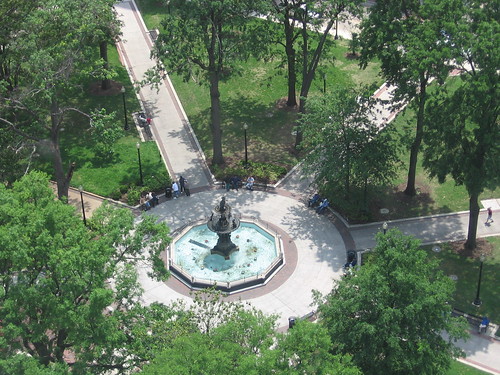
Memphis should be proud of the beauty that is Court Square.

Views from the Lincoln-American Tower

Views from the Lincoln-American Tower

Court Square from the Lincoln-American Tower

Court Square

Wireless in Court Square

But as Jane Jacobs observed, the beauty and amenities of a park aren't enough if the adjoining neighborhood lacks use and time diversity. More on that later.

Labels: , , , ,

Monday, March 31, 2008

Jane Jacobs in Practice

Sears Crosstown from VECA GreenlineAs I continue my slow read of Jane Jacobs' The Death and Life of Great American Cities, I have a question:

are there any cities who have explicitly implemented Jacobs' strategies in their planning practice?

I don't think Memphis has had much of her analysis, much less her practice.

Searching for an answer to the question above, I came upon the essay "Localism" by James Howard Kunstler, urbanist and social critic. It starts at farmers markets, ends with a vision of a post-Peak Oil urbanism, design and culture, and along the way gives us this:
Localism, in this sense, is very much related to the current craze for styling one’s endeavors as “green.” Tom Friedman cheerleads for “green” globalism in his New York Times column while Time Magazine runs “Greencast” programs on its website, and all kinds of specialists design green cars, green light bulbs, green toilets, green campuses, and green corporate headquarters (all the better for hawking those Cheez Doodles). Much of this activity can be described, to borrow a locution from public relations, as blowing green smoke up our own collective ass. Such, alas, is the sorry state of our culture nowadays that just pretending to mean well, for most people and institutions, is good enough.

I had originally come upon Kunstler via a link to his Eyesore of the Month, small essays on recent world-class starchitect atrocities. Here's my favorite.

Labels: , , , ,

Tuesday, February 19, 2008

Public Life in Los Angeles

lightpost and palm tree, Cahuenga Blvd., Hollywood, Los AngelesI have been in El Pueblo de Nuestra Señora Reina de los Ángeles sobre El Rio Porciuncula for the past week. Although the pueblo had internet access, I used it rarely.

Instead I walked and drove around alot and read (not finished) Jane Jacobs' The Death and Life of Great American Cities. She had something to say of Los Angeles in 1961:

Lowly, random and unpurposeful as they may appear, sidewalk contacts are the small change from which a city's wealth of public life may grow.

Los Angeles is an extreme example of a metropolis with little public life, depending mainly instead on contacts of a more private social nature.

True perhaps in 1961, but a lot less true in 2008. From what I saw, the street life of Los Angeles has become very rich. (An exception: the urban renewed parts of downtown Los Angeles. They are clean, modern and neat, but have few pedestrians.)

I think Los Angeles is moving from suburban sprawl towards major clusters of density based on mass-transit and neighborhood attraction. And with it is coming the strong public street life that Jacobs championed.

Memphis has much to learn from Los Angeles' transformation.

Labels: , , , ,

Thursday, January 17, 2008

Jacobs v. Moses v. Memphis

I've just finished listening to a podcast from the Architectural League of New York. It's from their 2006 forum, "Jane Jacobs vs. Robert Moses: How Stands the Debate Today".

Neither a bashing of Robert Moses nor deification of Jane Jacobs, there's a lot of relevance in it and the Jacobs/Moses dialectic to modern-day (and olden-day) Memphis.

For instance this quote from panelist Richard Kahan:
I have always viewed development in New York as a balance or imbalance of 3 basic forces: the public sector, the private sector and and the civic sector, within which I include neighborhood organizations, groups like the Municipal Arts Society, regional planning association, environmental groups, etc. And certainly Jane Jacobs was among the first, if not the first, to be organizing those kinds of forces. So the battle was no longer just about the public sector and the private sector.

In Memphis' case it appears that the public sector has rarely been the primary force (great exceptions: the laying out of Memphis with the Promenade and the 4 Squares; the creation of the Parkways, Overton Park and Riverside Park; possibly the reimagining of the LeMoyne Gardens and Dixie Courts housing projects). Mainly it's been a rubber stamp for the designs of the private sector and provider of commodity infrastructure for those designs.

And in the civic sector there's been great work, stretching from the fight to keep Interstate 40 out of Overton Park, through the battle for the Bluff Walk, and now to save Libertyland and to preserve the Riverfront. But it doesn't appear, yet, that we have a large and sustained civic movement that spans the time between the major struggles and the space between all our neighborhoods.

Labels: , , , ,