Friday, June 19, 2009

Beauty == Utility

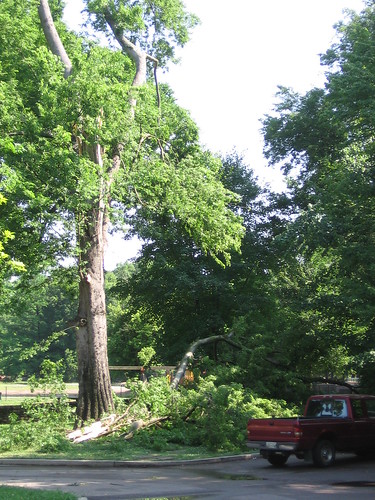
Storm Damage in Overton Park

The only voice of opposition at the Land Use Control Board's affirmative vote on the Unified Development Code a few weeks ago came from Memphis Light Gas & Water.The utility had a problem with several sections of the code, especially
A. New electric utility services shall be placed underground where functionally feasible...
(section 5.3.4)

I seem to remember the MLG&W rep stating that the aesthetics of the code would be a drag on functionality for utilities. A utility's utilitarian argument.

Yet the mass disruptions whipped up by last weekend's storms (mostly by trees and branches falling on above-grade power lines) and the historic storm data exposed by this NOAA map (hat tip Naomi)

show the impracticality of this opposition. Storms will cross the Mississippi, branches will fall from the sky, above-ground electric lines will get knocked out. But happily, safely, beautifully, increasingly buried electric lines will keep on humming.

Good aesthetics in tree-rich, storm-happy Memphis is good utility.

Labels: , , , , ,

Tuesday, June 09, 2009

Begin Again with Trees

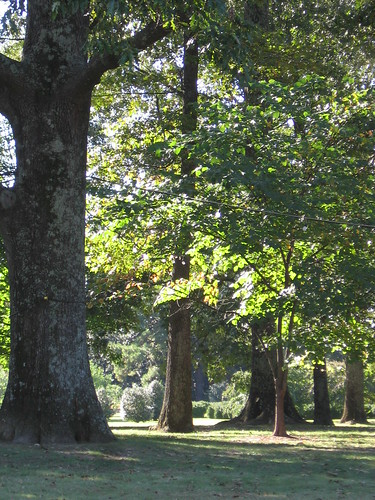
Memphis Botanic GardenIf you were alive in the Paris of Louis XIV, the impression of these new boulevards and avenues would be of a tremendous formalizing of nature, rather than of urbanization. The chief device, the parallel rows of trees was a fairly easy way to achieve stunning monumental effects and perspectives with little actual material and labor. These abstract diagrammatic schemes signified little beside the kings' ability to make a rural landscape orderly --something he clearly relished. However, when they finally were developed with buildings decades later, the boulevards and avenues of Louis XIV would become templates for the best of the Second Empire's new street typologies, and they remain models for excellent street sections into our time.
The City in Mind,
James Howard Kunstler
(emphasis mine)

Making ordered rows of great Memphis native trees could be the first, relatively easy step toward retrobeautifying our problematic ugly avenues and boulevards. Even -- especially -- in commercial districts.

Labels: , , , , ,

Monday, May 18, 2009

Wall of Trees


On my way to the Barbecue Fest last Friday I noticed this growing wall of trees on Main between Beale and Peabody Place. Eventually they should be as tall as, if not taller than, the buildings behind them.

The trees are inexpensively creating architectural space where demolition and a surface parking lot removed it 40 years ago. The feeling of enclosure helps bridge the walking gap between the Orpheum and the buildings and businesses north of Peabody Place.

Unfortunately, this is the only side of the block square parking lot that has trees, as you can see looking down the Beale side towards the River.

Maybe planting trees in an urban pattern is not as good as building, but it is something we can do now all over the city to begin filling chronic gaps.

Labels: , , , , ,

Tuesday, February 10, 2009

Green Space

I received an email recently from the Natural Resources Defense Council announcing their program called Picturing Smart Growth. It's a series of smart growth visualizations in 70 different communities, showing the path from the not so bright present to a much smarter future.

One of their featured scenarios is in Memphis, and specifically, a street around the corner from Stax and Soulsville (College Street? The actual street isn't listed.)

The first transition, from the present


to the first phase,


is what really caught my eye.

The trees not only beautify the street but alter it spatially, becoming architectural.

This spatial effect was confirmed for me by the great Suburban Nation
These trees are not intended merely to be decorative; rather they are included to create spatial definition when the buildings fail to do so. The trees narrow the space and provide a natural vault that contributes to the pedestrian's sense of enclosure and comfort.
So Memphis, space and cash poor but tree and land rich, could move inexpensively toward a smart, built future by planting trees as the official "Phase I" of all our neighborhood rebuilding. Even if they're just regularly spaced seedlings, the young trees will be placeholders for the space that will emerge beneath their vault.

Plus an ordered, ritual planting could provide a very immediate, on-the-ground beginning to charrette implementation. A simple, tangible, visible groundbreaking.

Memphis Botanic Garden

Labels: , , , , , ,

Wednesday, May 28, 2008

Seeds of Blight

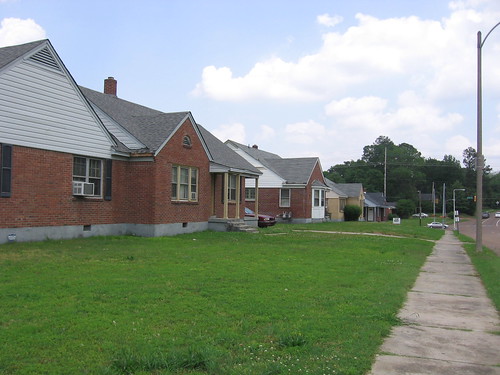
Rental Houses without trees

There's a fight against blight in the Eastview Neighborhood, just north of East High.

Eastview is a very visually distinct place. If you travel Walnut Grove at all, it really sticks out. Not because it's a bombed out urban wasteland, but because it has no trees. It has never had any trees*. Not many shrubs either.

This "feature" has always set this barren streets apart from neighboring streets, which might be one neighborhood if half hadn't been visually tagged as something so much different. The streets' age (around 50 years old), architecture (Cape Cod cottage in both), layout (quasi-cul-de-sac) and connections (the rental area is joined to the homeowner area by interior streets, not just Walnut Grove) do not set the areas physically apart. In fact, it's possible they were all built as part of the same development.

It's the trees that set them apart.

From outer space the rental homes (see below, lining the left and bottom) today look the same as the day Yuri Gagarin flew over, with that fresh subdivision look; the interior home lots (on the right and top) have changed as their trees and shrubs grew.

But on the ground, the bare homes are decaying; the lush homes are stable.

I'm not blaming the treelessness for the decline. But for half a century the landlords, wittingly or not, have marked these streets as different, perhaps even a problem, along tree-lined Walnut Grove.

In Eastview, landscape has been legacy.

* along Eastview Drive, 3 or 4 houses now have willow trees in their front yard. These are the only trees I saw in front of the rental houses. Willows sticking out along the curving, suburban-style, mostly barren street have added to the visual distinction of the neighborhood. A Leave it to Beaver ghost town.

Labels: , , , ,